
Apart from bringing new suppliers on board, Xiaomi is also hoping to take advantage of the newly launched PLI scheme that offers incentives on incremental production of smartphones with 2020 as the base year.

'A long-term investor with a 4 to 5 year horizon could invest in this theme via SIPs.'

'In terms of semiconductors, challenges do remain in the pan industry, but I think we are much better than where we were a year or so back.'
'If all goes well, we may well hit or even surpass the forecast growth rate.'

Rajan said the government focussed more on fulfilling its political and social agenda rather than paying attention to the economic growth.

Reliance Industries (RIL's) annual report released on Sunday highlighted the company's focus on new energy solutions, with chairman and managing director (MD) Mukesh Ambani stating that the age of fossil fuels will not continue much longer. RIL has sought shareholders' approval to give Ambani another five-year term as MD till 2029 at nil salary. The recently demerged Jio Financial Services, which "will leverage the prowess of digital and retail businesses", was expected to be listed soon.

Fitch Solutions on Thursday said the new climate targets announced at the COP26 summit by Prime minister Narendra Modi pose an upside risk to its outlook for renewable growth in the country. With the new targets, it expected to see attempts to alleviate the issues regarding supply chains, manufacturing and project development that have long plagued renewable proliferation.

Crisil Ratings on Wednesday projected India's GDP growth at 6.8 per cent in the next fiscal and said the country will become an upper middle-income nation by 2031 with the economy doubling to $7 trillion. In its India Outlook report, Crisil said the Indian economy will take support from domestic structural reforms and cyclical levers and can retain -- perhaps even improve -- its growth prospects to become the third largest economy by 2031. "After a better-than-expected 7.6 per cent this fiscal, India's real GDP growth will likely moderate to 6.8 per cent in fiscal 2025," said the Crisil India Outlook report.

India on Monday joined a US-led initiative to set up an Indo-Pacific Economic Framework to bind partner countries to achieve common goals, with Prime Minister Narendra Modi asserting that New Delhi will work with the stakeholders to make it an "inclusive and flexible" structure to pave the way for development, peace and prosperity in the region.

For the first time, the country's largest airline IndiGo will soon lease up to four wide-body Boeing 777 planes to cover the shortfall in its international operations, according to officials. The airline said the wet-leasing of "certain aircraft" will be done as an interim measure. IndiGo, which has so far only been operating narrow-body Airbus planes, ATRs and freighters, will now be having wide-body aircraft in its fleet.

'In India, the GenAI startup ecosystem is unfolding with remarkable speed, signalling a new era of technological advancement and investment opportunities.'

'I think we just got to make the protocol we set out: that if you're flying from China, you got to be tested, and so on'

Fund mobilisation by companies through equity and debt routes has dropped 20 per cent in 2022 to nearly Rs 11 lakh crore, as exuberance dwindled this year due to expensive credit avenues and volatile markets. The first half of 2023 could continue to remain challenging. The year 2021 was extraordinary for fundraising from the equity and debt routes, while 2022 has seen a slowdown in capital raising owing to elevated volatility provoked by unprecedented inflation globally and the Russia-Ukraine war.

Parle Agro, which sells beverages such as Frooti in small tetra packs, has already started importing paper straws. Dabur India, which sells its fruit juices in tetra packs under the brand Real, is also considering importing paper straws.
S&P Global Ratings on Monday cut India's economic growth forecast for current fiscal year to 7 per cent, but said the domestic demand-led economy will be less impacted by the global slowdown. S&P had in September projected the Indian economy to grow 7.3 per cent in 2022-23 and 6.5 per cent in next fiscal year (2023-24). "The global slowdown will have less impact on domestic demand-led economies such as India... India's output will expand 7 per cent in fiscal year 2022-2023 and 6 per cent in next fiscal year," S&P Global Ratings Asia-Pacific chief economist Louis Kuijs said.

The outbreak of the Omicron variant of the coronavirus and unprecedented lockdowns in China have roiled its equity market and also that of Hong Kong. After the crisis-hit Sri Lanka, China and Hong Kong are the worst-performing stock markets in Asia on a year-to-date basis.

'There were two options before the government -- create a complex, cumbersome law, which will cause a tremendous amount of compliance challenges for startups or say let's go back and do a clean slate, where we do a framework of laws and policies'

'Investors should keep them on their radar and invest over a longer time frame, and expect some of these companies to bite the dust.'

The defence minister also took an indirect dig at Gandhi for "doubting" the government's intention in the handling of the border row with China and said politics can not be done on the basis of "falsehood".

Amid China's economic slowdown, the country's economic challenges may increase manifold and its economy may be hit harder in the wake of the Ukraine-Russia crisis.

India must be prepared to deal with climate disasters, geopolitical confrontations, and social strife linked to global events, asserts Jayant Sinha, chairman of Parliament's Standing Committee on Finance.

The economic impact of the Omicron variant of COVID-19 on emerging economies will depend on a mix of government restrictions, public comfort with social interactions, and capacity of governments and central banks to provide additional policy support to the private sector, Moody's Investors Service said on Wednesday. The emergence of the new variant poses new risks to the global economic growth and inflation outlook, as concerns mount about the variant's health risks and several countries have imposed new travel restrictions in recent days. These restrictions will likely increase over the coming weeks until scientists learn more about the variant, it said.

also made a case for the need to create a self-sufficiency fund for innovation, construction and manufacturing clusters to make use of the emerging opportunities in the wake of disruption in global supply chain.
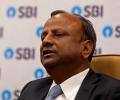
He said the SBI data showed that there is a rise in NPAs due to the coronavirus crisis but it is manageable as people have been cautious about increasing their liabilities especially in the retail, agriculture and MSME sectors.

With no rate cuts on the table, the other monetary policy alternative could be to reduce the width of the asymmetric policy corridor or increase in reverse repo rate when the pandemic subsides, they opined.

Shortages of chips will impact the car market

Even as India's passenger-vehicle sales touched a record high of 3.9 million units in 2022-23, growing 27 per cent over the previous financial year, the country's largest carmaker, Maruti Suzuki India (MSIL), said on Monday uncertainties in the electronic-component supplies might affect production in FY24. MSIL said the shortage of electronic components had some impact on production in FY23. "The company took all possible measures to minimise the impact.

India and China have made "some progress" in disengagement, External Affairs Minister S Jaishankar said on Sunday, describing it as a "welcome" move which opens up the possibility that other steps could happen.
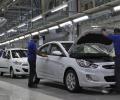
Leading carmakers Maruti Suzuki, Hyundai and Tata Motors reported robust dispatches to dealers in May on the back of strong demand for passenger vehicles across regions, even as the global semiconductor shortage continued to impact production. Mahindra & Mahindra, Kia India, Toyota Kirloskar Motor, Honda Cars and Skoda also witnessed strong demand for their models last month. The month of May also witnessed Tata Motors race ahead of Hyundai in terms of domestic wholesales.

Consumer-focused companies have been left with few options but to increase the prices of their products as input costs mount because of various factors, including supply chain disruptions. This has been affecting monthly household budgets. Prices of scores of items -- from spices to soaps to rice -- have increased in the past year.

A depreciating rupee, which briefly hit 80 to the dollar on Tuesday, may boost India's exports but price-inelastic imports of crude oil and gold would mean limited relief on the trade deficit, which clocked a record $26.2 billion in June. Due to global risk aversion on the back of geo-political tensions and aggressive policy tightening by the Fed, the dollar has appreciated against most currencies, including the rupee. And, with other currencies depreciating, India's comparative advantage in this respect may be limited.
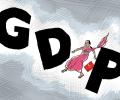
India's Gross Domestic Product (GDP) is expected to expand by 9.2 per cent in the current financial year, according to the Economic Survey 2021-22 tabled in the parliament on Monday. "Advance estimates suggest that the Indian economy is expected to witness real GDP expansion of 9.2 per cent in 2021-22 after contracting in 2020-21. "This implies that overall economic activity has recovered past the pre-pandemic levels," Economic Survey noted. Almost all indicators show that the economic impact of the "second wave" in Q1 was much smaller than that experienced during the full lockdown phase in 2020-21 even though the health impact was more severe, it said.

'If the almost literally heart-stopping Suez block has any positive outcome, it is to be hoped that it will accelerate the setting up of a fab (perhaps Taiwanese) in India,' asserts Rajeev Srinivasan.

China's covid crisis could provoke a raw material crunch for India's EV industry later this year.

Their favourite alternatives: Malaysia, Vietnam and the Philippines. Note, India is missing from that list. And this is despite an attractive financial incentive scheme for OSAT players. The reason, said a senior executive of a US chip company who had a meeting in Taiwan just a few weeks ago, is that "they want more predictability in government policy because they plan to put in big money."

Besides growing tech and digital enhancements, the firms are ramping up the hiring of more delivery partners and reinforcing existing Covid protocols.

The sharp correction in equity markets has taken a toll on mid-and-small cap stocks that have underperformed their large-cap peers. Thus far in calendar year 2022 (CY22), the mid-and-small cap indexes on the BSE have slipped over 8 per cent and 7 per cent respectively, as compared to a fall of around 6 per cent in the S&P BSE Sensex. While investors dumped mid-and small-cap stocks as the markets remained choppy over the past few weeks, analysts still expect these two segments to see good investor interest from a medium-to-long term perspective.

Passenger vehicle dispatches from factories to dealers declined 13 per cent to the lowest level in five years in December last year as the industry continued to face production issues due to semiconductor shortage, auto industry body SIAM said on Friday. Passenger vehicle dispatches last month stood at 2,19,421 units compared to 2,52,998 units in December 2020. While acknowledging that the chip shortage situation is not expected to dramatically change in the short term, the industry body expressed hope that things will improve soon.
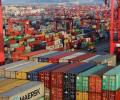
Indian exporters are keeping their fingers crossed on account of rising Covid infections in China and other countries as it could again disrupt supply chains and affect demand for goods. Federation of Indian Export Organisations (FIEO) director general Ajay Sahai said that if the cases continue to increase in the coming days, it may have implications on imports. "We are keeping our fingers crossed," he said.

India's gain will be an additional business of $300 million to $400 million per month if 10-11% of Bangladesh's export is diverted to Indian hubs like Tiruppur.
